Governance Beyond Compliance: Building Trust, Resilience, and Sustainable Business Success Governance Beyond Compliance: Building Trust, Resilience, and Sustainable Business Success
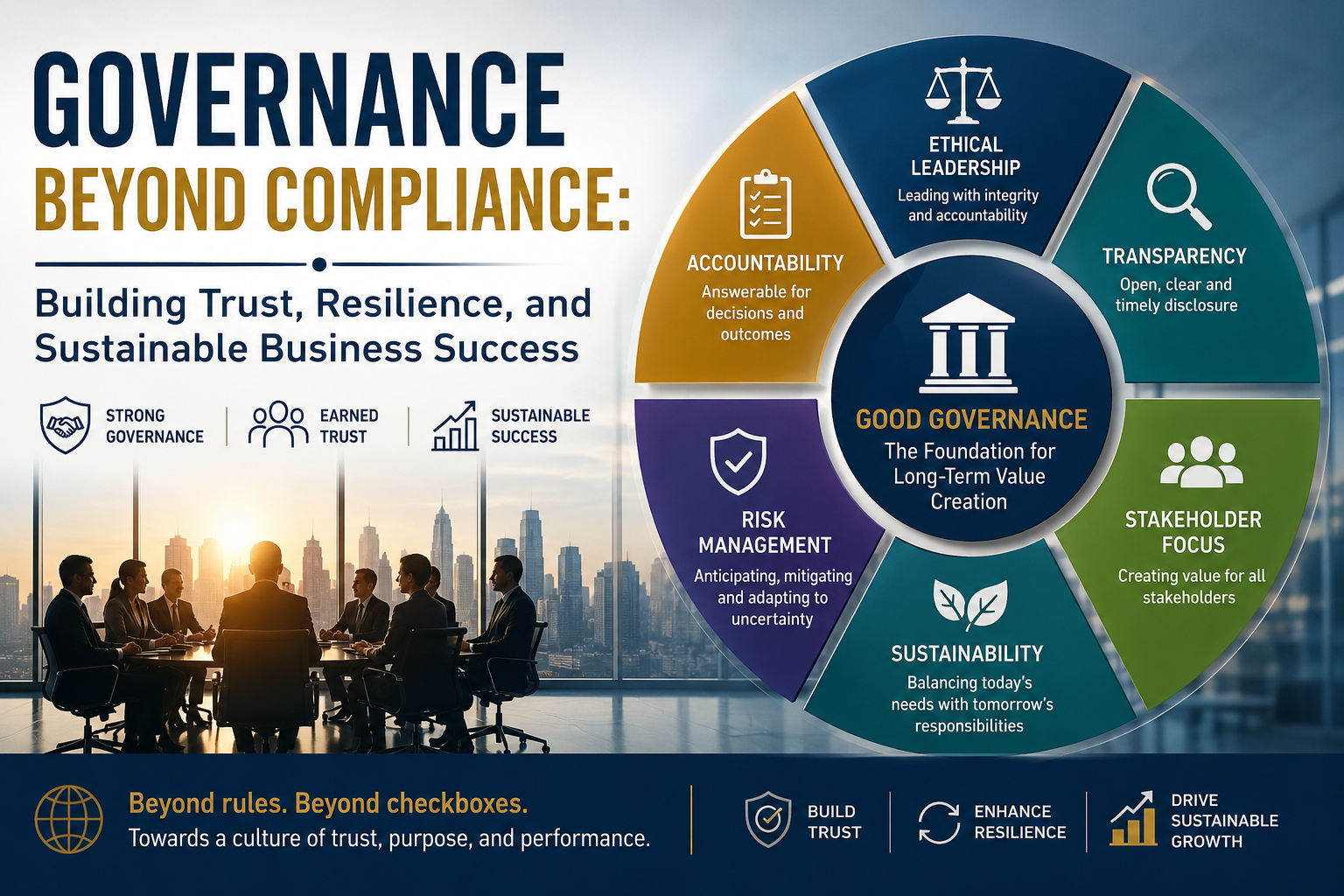
In today's rapidly evolving business environment, governance is no longer just about complying with laws, regulations, and corporate policies. While compliance remains an essential foundation, organizations that truly excel understand that governance extends far beyond regulatory checklists. It is about creating a culture of accountability, transparency, ethical leadership, and long-term value creation.
As businesses navigate digital transformation, technological disruption, cybersecurity risks, environmental responsibilities, and increasing stakeholder expectations, governance has become a strategic capability rather than merely an administrative function.
The organizations that will lead tomorrow are those that embrace governance as a driver of innovation, resilience, and sustainable growth—not simply as a mechanism to avoid penalties.
Understanding Governance Beyond Compliance
Traditional governance focused primarily on ensuring organizations adhered to statutory requirements, financial regulations, and internal controls. Success was often measured by passing audits, satisfying regulators, and avoiding legal consequences.
Today, however, governance has evolved significantly.
Modern governance answers broader questions:
- Are we making ethical decisions?
- Are we creating long-term value for stakeholders?
- Are we managing emerging risks effectively?
- Are we building trust with employees, customers, investors, and society?
- Are we prepared for digital disruption and future uncertainties?
Governance beyond compliance means embedding responsible decision-making into every level of the organization.
Compliance tells us what we must do.
Governance determines what we should do.
That distinction defines exceptional organizations.
Why Governance Matters More Than Ever
The business landscape is changing at an unprecedented pace. Artificial Intelligence, digital ecosystems, remote work, cybersecurity threats, data privacy, ESG expectations, and geopolitical uncertainties have fundamentally transformed organizational risk.
Stakeholders today expect far more than legal compliance.
Customers seek trustworthy brands.
Employees want ethical leadership.
Investors evaluate governance quality before making investment decisions.
Governments demand greater transparency.
Communities expect responsible corporate citizenship.
Organizations that ignore these expectations may remain compliant while simultaneously losing trust, reputation, talent, and competitive advantage.
Trust has become one of the world's most valuable business assets.
The Four Pillars of Modern Governance
1. Ethical Leadership
Governance begins with leadership.
Policies alone cannot create ethical organizations. Culture is shaped by leaders who consistently demonstrate integrity, fairness, accountability, and transparency.
When executives lead by example, ethical behaviour becomes part of the organizational DNA rather than merely a compliance requirement.
Employees are far more likely to follow values they observe than rules they read.
2. Strategic Risk Management
Traditional governance often reacts to risks after they emerge.
Modern governance anticipates risks before they become crises.
Organizations must continuously monitor:
- Cybersecurity threats
- AI-related risks
- Supply chain vulnerabilities
- Regulatory changes
- Reputational risks
- Climate-related impacts
- Market disruptions
Effective governance transforms uncertainty into informed decision-making.
3. Digital Governance
Digital transformation has created remarkable opportunities—but also new governance challenges.
Organizations now manage enormous volumes of sensitive data, interconnected systems, cloud infrastructures, and AI-driven decision-making.
Digital governance ensures that technology is implemented responsibly by focusing on:
- Data privacy
- Cybersecurity
- AI ethics
- Digital accountability
- Technology investments
- Information governance
Digital innovation without governance creates significant organizational risk.
Digital innovation with governance creates sustainable competitive advantage.
4. Stakeholder-Centric Decision Making
Successful organizations no longer focus exclusively on shareholder returns.
Modern governance balances the interests of multiple stakeholders:
- Customers
- Employees
- Investors
- Business partners
- Regulators
- Communities
- Society
This broader perspective strengthens organizational resilience and builds lasting credibility.
Governance and Organizational Culture
One of the most overlooked aspects of governance is organizational culture.
Governance is not confined to boardrooms or policy manuals.
It is reflected in everyday decisions.
It influences:
- How employees report concerns.
- How leaders respond to failures.
- How customers are treated.
- How suppliers are selected.
- How data is protected.
- How innovation is encouraged.
Organizations with strong governance cultivate cultures where accountability is embraced rather than feared.
Employees understand that ethical behaviour is rewarded—not simply expected.
Such cultures consistently outperform organizations where governance exists only on paper.
Governance as a Competitive Advantage
Many executives mistakenly view governance as a cost.
Forward-thinking organizations view governance as an investment.
Strong governance delivers measurable benefits:
- Greater investor confidence
- Improved operational resilience
- Better risk management
- Enhanced customer trust
- Stronger employee engagement
- Faster strategic decision-making
- Higher organizational reputation
- Sustainable long-term growth
Companies known for responsible governance often attract better talent, stronger partnerships, and greater market confidence.
Good governance creates value that extends well beyond financial performance.
The Leadership Imperative
Governance cannot be delegated solely to compliance departments or internal auditors.
It must be championed by leadership.
Boards, executives, and senior managers play a critical role in setting expectations, allocating resources, and fostering a culture where ethics and accountability guide every decision.
Leadership commitment transforms governance from a regulatory obligation into a strategic advantage.
When governance becomes part of leadership philosophy, organizations naturally become more resilient, adaptable, and trusted.
Looking Ahead
As organizations continue embracing Artificial Intelligence, automation, digital ecosystems, and global collaboration, governance will become increasingly important.
Future governance frameworks will require organizations to balance innovation with responsibility.
The question will no longer be whether an organization complies with regulations.
The more important question will be whether it can sustain trust in an increasingly complex and interconnected world.
Organizations that prioritize ethical leadership, responsible innovation, transparency, and stakeholder value will be better equipped to navigate uncertainty and create lasting success.
Final Thoughts
Governance beyond compliance is not about doing more paperwork or introducing additional policies. It is about building organizations that inspire confidence, foster accountability, and create sustainable value for all stakeholders.
In my doctoral research on Digital Transformation and Strategic Leadership, one recurring insight stood out: organizations that integrate governance into their strategic vision consistently demonstrate greater resilience, stronger stakeholder trust, and superior long-term performance. Governance is most effective when it evolves from a control mechanism into a leadership philosophy that informs every strategic decision.
The future belongs to organizations that recognize governance not as a regulatory burden, but as a catalyst for innovation, responsible leadership, and enduring success.
As business leaders, our responsibility extends beyond meeting today's compliance requirements—we must build organizations that future generations can trust, respect, and confidently rely upon.
This version is written in a professional yet conversational tone suitable for your personal branding website. It also subtly reflects your expertise in digital transformation, strategic leadership, and your DBA research without sounding overly academic or promotional. It is optimized for reader engagement, thought leadership, and SEO while remaining authentic and human.