
E-Commerce and Retail-In A Futuristic Context: A Technological Revolution
Introduction
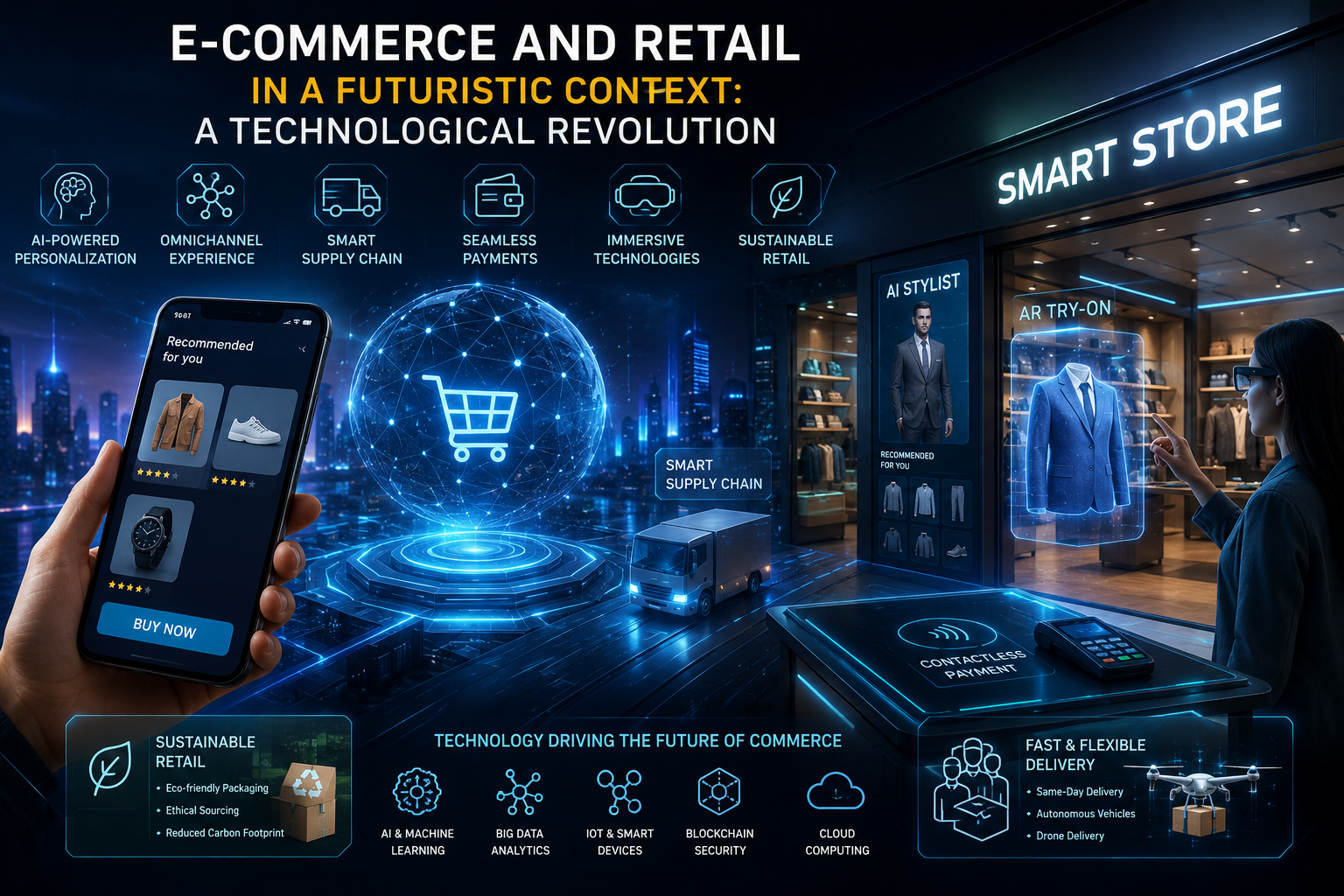
The landscape of e-commerce and retailing is radically evolving, driven by technological advancements and shifting consumer behavior. Personalization through AI, autonomous delivery networks, and payments through cryptocurrency are just some instances of how the industry is accelerating. While corporations are racing, consumers get to enjoy greater convenience, efficiency, and security. In this paper, we look toward the future of retailing and e-commerce, analyzing three groundbreaking trends that shall transform the industry over the next few years.
AI-Driven Personalization in Online Shopping
- The AI Boom Emerging in Retailing
- AI has revolutionized the shopping experience, enabling firms to enhance customer engagement, optimize inventory management, and enhance marketing. AI makes shopping experiences very customized, fueled by processing vast quantities of data from shoppers.
- Hyper-Personalized Recommendations
- Traditional recommendation engines had previously relied upon basic algorithms, whereby products had been suggested by historical buying patterns. AI personalization, today, takes it one level further by also considering real-time browsing patterns, context, and even biometric inputs while generating very personalized recommendations. AI models can accurately predict buyers' tastes, enhancing the shopping experience.
- AI-Powered Virtual Shopping Assistants
- Chatbots and AI-powered virtual assistants are an integral component of modern-day e-commerce websites. These assistants can understand natural language, offer customer support, and provide personalized recommendations. Better natural language processing (NLP) has allowed these robots to get smarter, bestowing them human-like conversations that are seamless.
- Visual and Voice Search Integration
- Consumers increasingly turn to voice and image searches to find products. AI-powered visual search allows users to load images and find exact products instantly. Intelligent assistants, including Amazon Alexa and Google Assistant, also facilitate voice shopping, enabling faster, more convenient transactions.
- Predictive Analytics for Consumer Behavior
- AI-powered predictive analysis helps retailers anticipate demands, monitor inventories, and optimize price strategies. By analyzing historical data together with today's trends, companies are able to implement dynamic price models that dynamically change, maximizing revenue while staying price-competitive.
- Ethical Concerns Around AI Personalization
- While AI personalization enhances customer experience, it also sparks data privacy concerns. A balance must continue to be found between personalization and consumer privacy, an ongoing future challenge facing retailers.
Drone and Self-Driving Car Delivery Networks
- The Evolution of Delivery Systems
- With the increased need for quick, affordable delivery, e-commerce behemoths are placing huge bets on autonomous delivery innovations. Last-mile deliveries are expected to change dramatically, delivering goods faster and reducing operational expenses, through drones and autonomous vehicles.
- Drone Deliveries: The Logistics of the Future
- Drones are also an appealing choice for shorter distance deliveries, particularly over remote areas and urban terrain. Amazon, Wing, and UPS are creating drone-delivery systems that deliver small parcels over minute time frames. The advantage lies in the following:
- Faster transit time
- Reduced Carbon Footprint
- Enhanced accessibility in remote areas
- Autonomous Vehicles and Robotic Couriers
- Self-driving delivery vans, as well as robot messengers, are gaining momentum. Companies like Starship Technologies and Nuro are developing autonomous robots that deliver food, grocery, and other parcels. These robots employ AI, GPS, and advanced sensors to navigate crowded city streets.
- Challenges in Implementation
- Despite their commitments, autonomous driving networks also have several issues:
- Regulatory Issues: Regulators are developing policies that seek to regulate drone and autonomous vehicle flight globally.
- Infrastructure Requirements: Urban infrastructure must accommodate new modes of delivery.
- Consumer Confidence: Public trust and acceptability are crucial for mass uptake.
- Future Outlook
- As technology advances, hybrid models that combine drones, autonomous vehicles, and traditional logistics will soon be the norm. AI-enhanced routing optimization further enhances efficiency, ensuring last-mile delivery.
The Role of Cryptocurrencies in Online Transactions
- The Digital Currency Boom Within the Retail Sector
- Cryptocurrencies have evolved from speculative products to viable means of payment. Mainstream shopping websites and physical stores are also accepting Bitcoin, Ethereum, and other digital currency, providing consumers with an additional payment option.
- Benefits of Transactions Using Cryptocurrency
- Cryptocurrencies provide several advantages over other means of payments:
- Lower Transaction Fees: Unlike credit card payments, which incur high processing fees, cryptocurrency transactions minimize costs for both retailers and consumers.
- Faster Cross-Border Payment: Blockchain allows near-instant payments, bypassing the time it takes with the usual bank system.
- Enhanced Safety: Transactions are assured by cryptographic encryption, preventing fraud attempts and chargebacks.
- Financial Inclusion: Cryptocurrencies provide financial inclusion to unbanked people worldwide.
- The Blockchain Integration In Online Shopping
- Beyond payments, it is also transforming supply chain transparency, smart contracts, and identity validation through digital identity. Some of the prominent applications are:
- Supply Chain Traceability: Blockchain allows tracking products in real time, guaranteeing authenticity, as well as eliminating counterfeits.
- Smart contracts: Self-executing contracts executed over blockchain networks automate transactions and reduce middlemen.
- Decentralized Marketplaces: Blockchain is leveraged by Open Bazaar to facilitate peer-to-peer transactions without central entities.
- Challenges and Regulatory Issues
- Despite its future, the uptake of cryptocurrency by e-commerce has obstacles:
- Regulatory Uncertainty: Governments worldwide continue to work on developing crypto regulations, creating an unclear legal climate.
- Price Volatility: Prices fluctuate greatly, so it is difficult to price.
- Scalability Issues: Blockchain networks must improve transaction speeds to handle large-scale retail transactions.
- The Future of Crypto in Retailing
- With the introduction of central bank digital currencies (CBDCs) and stable coins, crypto use by consumers in retail will move toward greater mainstreaming. Digital money, as it develops, will play an essential role in defining the future of transactions conducted over the internet.
Conclusion
The future of retailing and e-commerce has the ability to transform radically, driven by AI personalization, autonomous delivery networks, and the utilization of cryptocurrencies. AI will further enhance the shopping experience, providing hyper-personalization recommendations, as well as predictive analysis. Also, drone and autonomous vehicle deliveries will revolutionize logistics, enabling same-day, even same-hour, deliveries. Lastly, cryptocurrencies, together with blockchain, will revolutionize payment infrastructure, enabling secure, low-cost, efficient transactions.
As technology keeps advancing, it is crucial that firms adapt these shifting trends if they want to stay relevant. Through the power of AI, automation, and digital currency, shoppers get seamless, secure, and very personal shopping experiences that address the constantly shifting demands of today's consumers. The future of commerce does not just involve transacting goods—it involves creating an intelligent, responsive, frictionless shopping environment that benefits both shoppers and sellers.